Onshore Wind Project Finance Model
Onshore wind project finance model: P50 and P90 cases, debt sculpted on the lender case with a gearing cap, equity and project IRR on P50, verified cell by cell
Choose the licence on the Gumroad page. Payment and VAT are handled by Gumroad, the merchant of record.
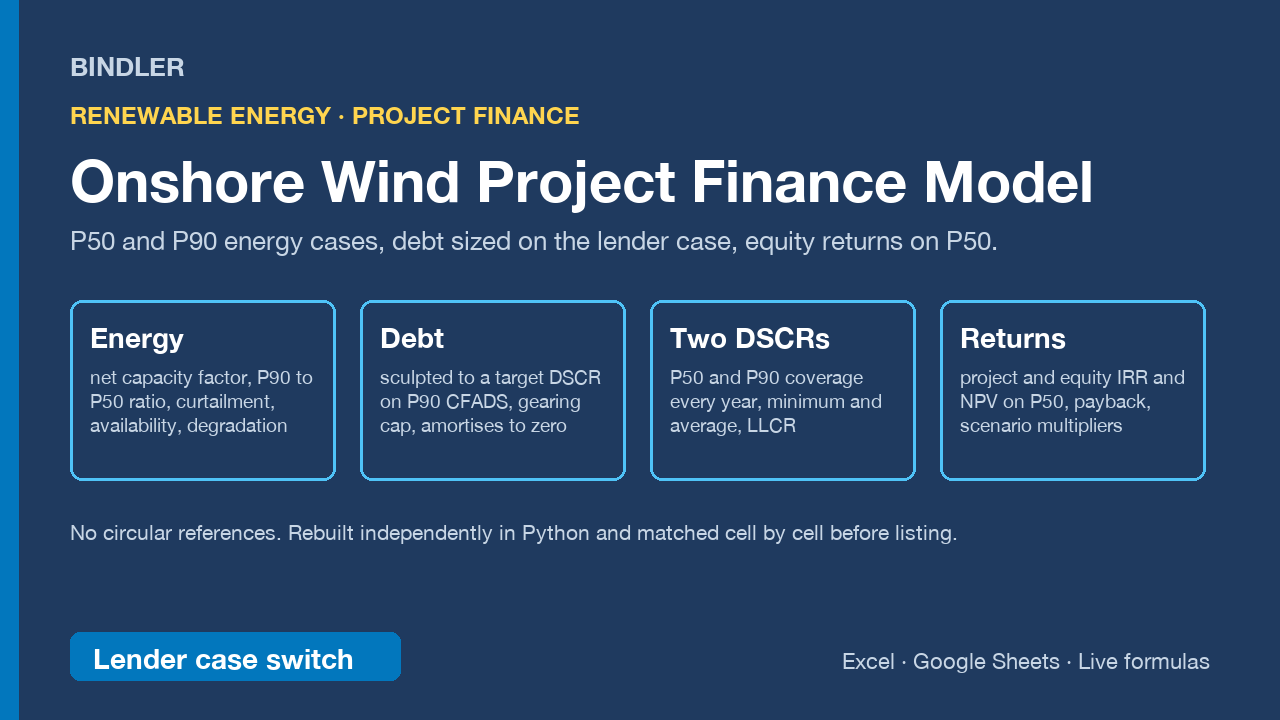
A single-asset onshore wind project finance model built the way lenders and sponsors expect, with the one thing solar models do not need: two energy cases. P50 is the expected yield and drives the equity view; P90 is the one-year exceedance case lenders size debt on. The model carries both through generation, revenue, EBITDA and tax, sizes debt on the case you choose, and reports DSCR on both.
- Inputs sheet: installed capacity, net capacity factor (P50), P90 to P50 ratio from the resource assessment, curtailment, availability, degradation, operating life, capex per MW plus grid, roads, land and development, financing fees, PPA price, term and escalation, merchant price and inflation, O&M per MW and fixed costs with escalation, target DSCR, maximum gearing, interest rate, tenor, tax rate, depreciation period, discount rates, the debt sizing case switch (P50 or P90), and three scenario multipliers (price, capex, energy).
- Operations sheet: P50 and P90 generation, price, revenue in both cases, opex, EBITDA in both cases, depreciation, unlevered tax in both cases, CFADS for sizing on the chosen case, and the unlevered P50 project cash flow, for every year.
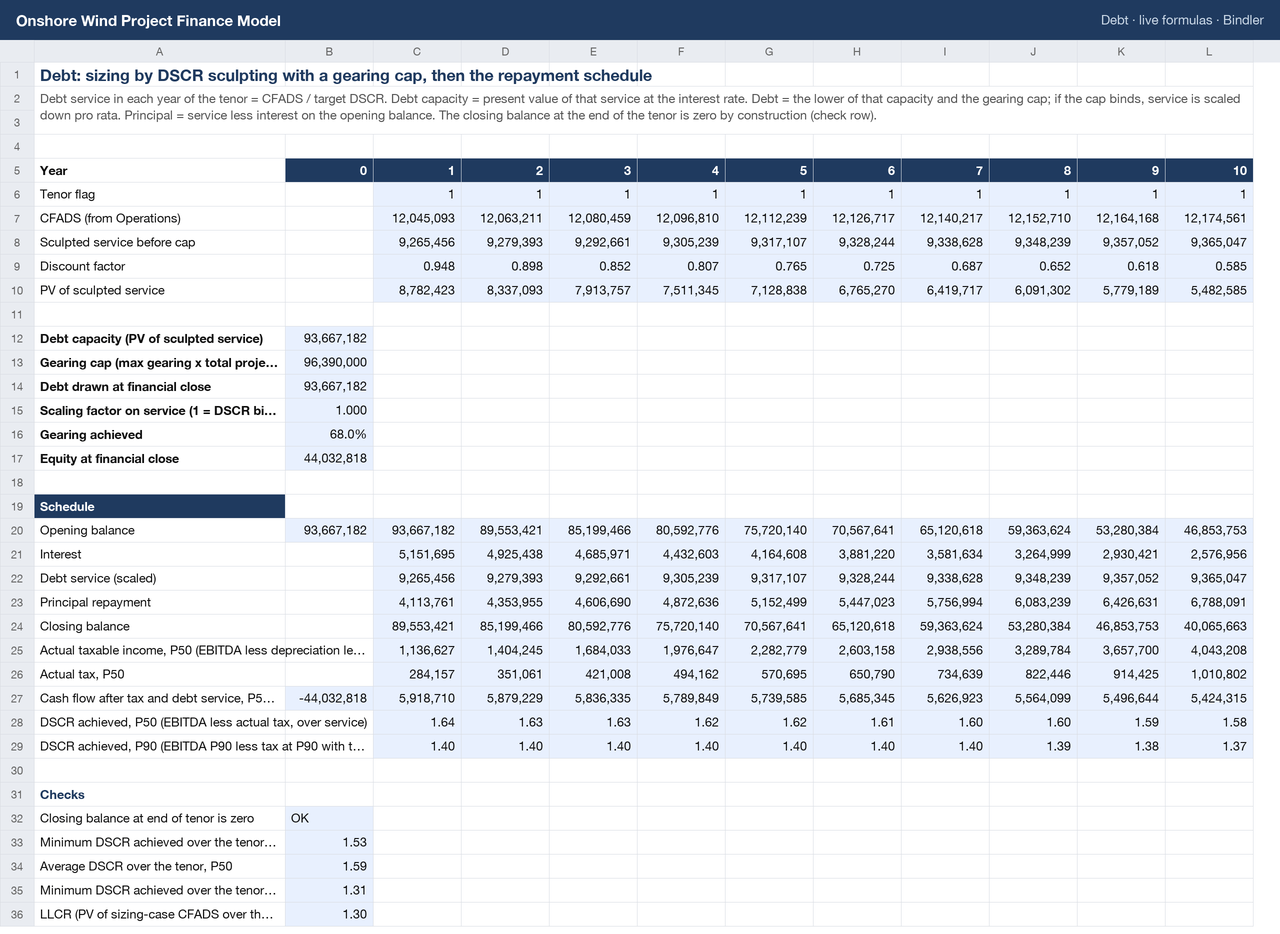
- Debt sheet: service sculpted to the target DSCR on sizing-case CFADS, debt capacity as the present value of that service, the gearing cap, pro rata scaling when the cap binds, the full schedule (opening, interest, service, principal, closing), actual tax with the interest deduction, equity cash flow, DSCR achieved on P50 and on P90 each year, minimum and average DSCR, LLCR, and a check that the balance reaches zero at the end of the tenor.
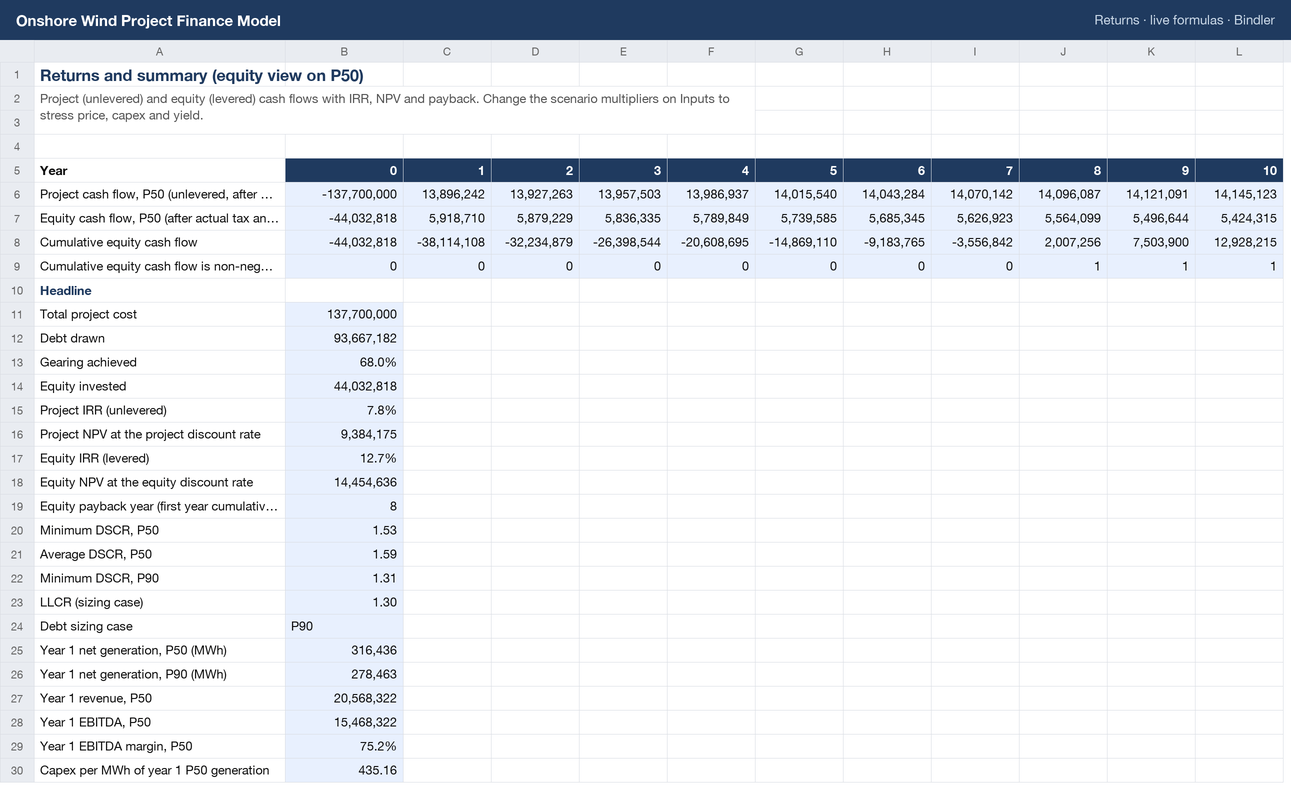
- Returns sheet: unlevered and levered cash flows, project IRR and NPV, equity IRR and NPV, payback year, both minimum DSCRs, year 1 generation in both cases, headline figures.
Design choices are written on the Guide sheet: debt sizing uses unlevered tax to avoid a circular reference (conservative for lenders), construction is a single point at year 0, one tranche, no DSRA or cash sweep, P90 applied as a constant ratio to P50. Every default is an example value, not market data, and the Inputs sheet says so. The model was rebuilt independently in Python and matched cell by cell (debt capacity, schedule, taxes, both DSCR series, both IRRs) before listing. Live formulas, no macros, no locked cells. Excel and Google Sheets.
Who it is for: developers sizing debt before a term sheet, investors screening a wind project, students learning why lenders look at P90 and equity looks at P50. Pairs with the Bindler Solar PV Project Finance Model, which shares the structure.
What is inside
1 Excel workbook (.xlsx), sheets: Returns, Inputs, Operations, Debt, Guide
Use it if
You are sizing debt, screening a wind project or learning how P50 and P90 cases drive debt capacity.
Not for
You need a construction draw schedule, multiple tranches, a DSRA or a cash sweep; those are not in this version.
Sheet previews
How buying works
- Choose a licenceSingle user for one person, team for up to 10, consultancy to use with clients. The buttons above go to the Gumroad page.
- Pay on GumroadCard or PayPal; Gumroad is the merchant of record and handles VAT and the receipt.
- Download the fileThe .xlsx arrives on the receipt page and by email. It opens in Excel and Google Sheets; nothing to install.
- Use itYellow cells are inputs, blue cells are formulas, every figure names its source. Questions: reply to the receipt; every reply is read and answered, usually the same day.
Search terms this page answers: wind farm project finance model excel, p90 debt sizing dscr sculpting, onshore wind financial model template.